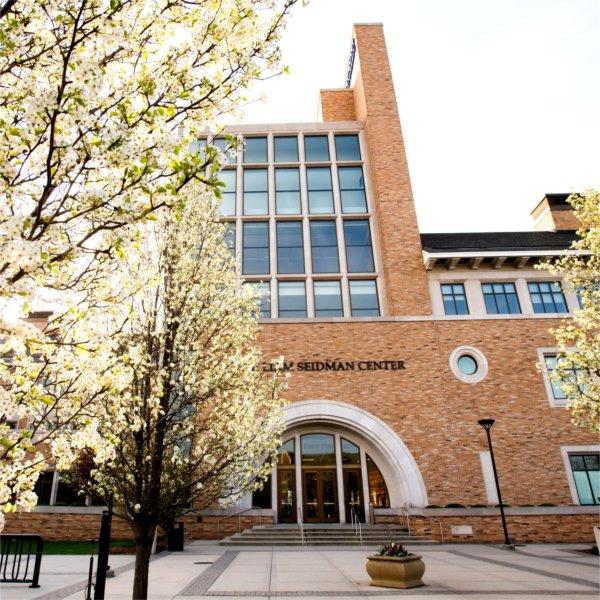
Grand Valley State University's new Glenn A. Niemeyer Learning and
Living Center continues the university's commitment to sustainable
development — a commitment that balances environmental, economic and
social responsibility.
The center is designed to meet the U.S. Green Building Council’s LEED
standards, which call for high performance and sustainability by
maintaining standards for water and energy conservation, material
selection and indoor environmental quality. James Moyer, Grand Valley’s
assistant vice president for Facilities Planning, said the building goes
a long way in improving Grand Valley’s commitment to sustainability with
the use of eight rain gardens, green roofs and an infiltration system.
“We used to have 100 percent water runoff in the parking lot. Our site
will now consume 60 percent of water runoff,” Moyer said.
Project manager Karen Ingle said the lighting system in the facility
includes occupancy sensors, daylight harvest sensors, scheduled light
controls and multi-level switching. She said the apartments have Energy
Star appliances and the laundry rooms have high-efficiency washers and dryers.
“The facility also has low-flow faucets and showerheads, dual flush
toilets and waterless urinals,” said Ingle. “This is estimated to reduce
water consumption by 37 percent, which is about 1.4 million gallons per year.
The construction of the facility was also eco-friendly. Wherever
possible, the materials used in the building’s construction were locally
manufactured and made of recycled materials. Much of the construction
waste was recycled.
Niemeyer Learning and Living Center is not Grand Valley’s only building
built to LEED standards. Muskegon’s Michigan Alternative and Renewable
Energy Center is certified LEED Gold; Lake Ontario Hall is certified
LEED Silver; and Kennedy Hall of Engineering is also LEED certified.
LEED certification is pending for Niemeyer Learning and Living Center
and the new Laker Turf building, as well as for renovations and
additions to Kirkhof Center and Mackinac Hall. The university is also
pursuing LEED certification for its entire Allendale Campus.
The emphasis on green building is part of a university-wide push toward
environmental responsibility. Grand Valley has signed the AASHE
President's Climate Agreement, which is a high-visibility effort on part
of institutions of higher education to neutralize greenhouse gas
emissions that is beginning to set the pace for Grand Valley to lower
it's carbon footprint. The university has also signed the Talloires
Declaration, which is an official statement of commitment to
environmental sustainability in higher education. The university has
encouraged mass transit, and bus ridership has increased from fewer than
40,000 per month in 2002 to more than 275,000 rides per month by 2007.
Grand Valley is getting an increasing amount of national attention for
its sustainability work. The university was honored by the U.S. Green
Building Council for its campus-wide sustainability programs. Grand
Valley was the only Michigan school cited Kaplan College Guide 2009,
which this year focuses for the first time on environmentally
responsible schools and green careers. Grand Valley was listed as one
of 25 “cutting-edge green” colleges and universities.
Niemeyer Learning and Living Center's Sustainability Features
Sep 11, 2008


Subscribe
Sign up and receive the latest Grand Valley headlines delivered to your email inbox each morning.