Kennedy Hall of Engineering expands academic learning spaces
Oct 17, 2007


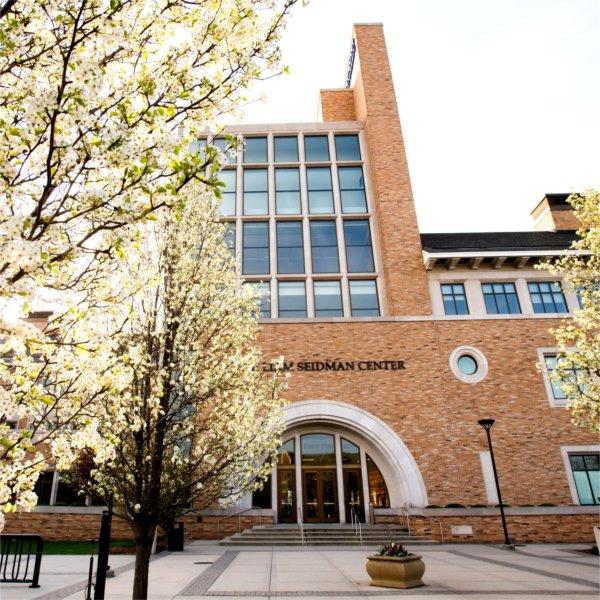
GRAND RAPIDS, Mich. — The John C. Kennedy Hall of Engineering, a three-story building of sleek steel, glass and concrete, has a distinct front entrance, while connecting to both the Eberhard Center and Keller Engineering Laboratories on the Pew Grand Rapids Campus.
The 52,000-square-foot building contains 21 cutting-edge labs, several specialty classrooms, office space and a multitude of unique energy-saving features that make this great learning environment great for the environment. Kennedy Hall provides much-needed space for the growing number of engineering students and faculty. And, the relocation of the engineering programs to the new building makes existing space in the Eberhard Center available for the College of Education.
“It expands our capacity tremendously,” said Paul Plotkowski, dean of the Padnos College of Engineering and Computing. “Not just capacity of how much we can do but also capability of what we can do.”
The building will feature the university’s first electron microscope. “Our students do a great deal of work that students at other universities do not do,” Plotkowski said. “They spend a lot of time designing and building and testing using industry standard tools. We now have an electronic assembly lab that will allow us to produce an entire circuit board, fully populated, with all of the components using robotic automation to populate it and solder everything. Students can do it all.”
For the first time, students will be able to work in a wireless and radio frequency lab that includes isolation for the design and testing of very sensitive wireless and radio frequency devices and antennas. Another new lab was designed for educational development where faculty can prototype, pilot and work out the bugs of new instructional methods and new laboratory experiments before they get in front of the students. A new “clean room” was designed for students working with microelectronic fabrication.
Engineering students and faculty members have always been committed to K-12 outreach and work with local industry, but space was a limiting factor. The Kennedy building includes a service learning laboratory where elementary and high school students can learn and industry seminars can be held.
The building was carefully designed to support study habits and personal learning styles of engineering students. “The entire building is accessible to students and faculty, 24-7,” said Plotkowski. “Students carry key cards for access. So, if they prefer to work on the computers at 3 a.m., they can do so.”
The design plan included research space for students and faculty for advanced technology projects. Plotkowski describes the design like an English muffin — with lots of nooks and crannies. “We took those nooks and crannies and turned them into student work spaces,” he said. “The two largest ones are student-faculty collaboration spaces, where a common work and study area is surrounded with faculty offices. That’s so students and faculty are accessible to one another outside of the classroom and after-hours.”
Subscribe
Sign up and receive the latest Grand Valley headlines delivered to your email inbox each morning.