
Blog
Green: The Color of Life and Death
March 01, 2026
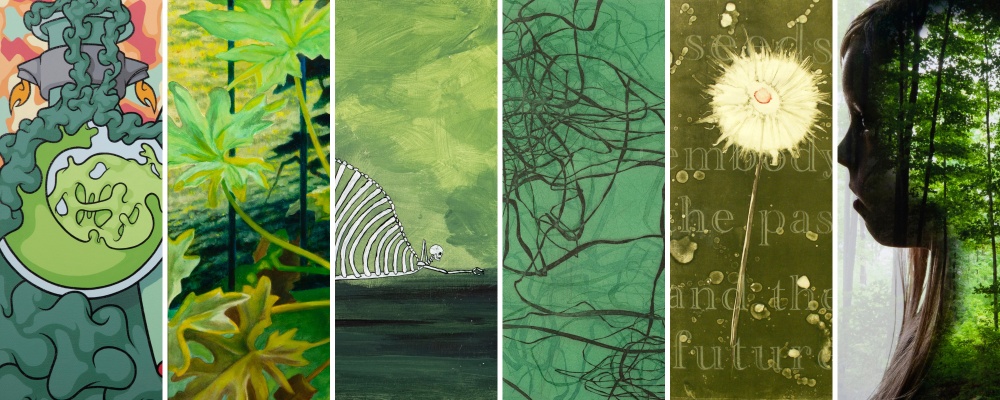
As the snow begins to melt and we move towards the equinox, small hints of spring will slowly begin to show. Tiny bits of green will pop through dingy greys left behind by a long Michigan winter.
Green is the most common color in nature, from the green chlorophyll of plants and leaves to animals that take on a green hue to camouflage themselves. For generations, green has represented life and vitality. Despite the wide variety of shades of green in nature, green is notorious for being one of the hardest colors to recreate for artists, as plant-based dyes quickly turn brown after being removed from the plant.
Throughout art history, pure green pigments are rare. Some of the earliest shades of green found in artwork came from the ancient Egyptians, who used the mineral malachite, but it was expensive and had the tendency to turn black. Ancient Romans soaked copper in wine and created verdigris, the blue-green patina that copper is known for, but the green produced didn’t reflect the vibrant shades of naturally occurring green.
The 19th century saw rapid improvements in pigment production. For centuries, artists relied on mixing colors to create green hues, but with the rise of industrial chemistry, new synthetic greens were developed. These greens were brighter and more intense than anything seen before.
One of these greens was called Scheele’s Green. Invented in 1775 by Carl Wilhelm Scheele, it was widely used in early Victorian wallpapers, textiles, children’s toys, and even candy. The color was made through a process of heating sodium carbonate, adding arsenious oxide, stirring until the mixture was dissolved, and then adding copper sulfate to the final solution. With the high arsenic content, Scheele’s Green eventually caused severe health issues to those who wore or consumed it. It could also release poisonous arsenic gas when it became damp. Many believe that this history is the reason green has also come to represent evil, decay, and sickness.
Today, artists have an abundance of (very stable and non-deadly!) modern green pigments to choose from. Looking through the GVSU Art Museum collection, which ones do you think represent life and vitality, or which ones represent the darker side of the color green?
Explore the many shades of green in the GVSU Art Museum Collection!
Andre Ray, Experiment No.7, acrylic on canvas, 2022, 2023.19.4.
L. William Blandford, First Light, oil on board, 1993, 1999.939.1.
Joel Addis, Homo Oefendicanus, acrylic on panel, 2005, 2005.390.1.
Bill Hosterman, Green Pulse, etching, 2004.459.1.
Alynn Guerra, Seeds Embody the Past and the Future, monotype,
2009, 2009.40.18.
Kelly Trisch, Silvia in the Woods, photograph, 2012, 2012.68.3.