
Blog
Captured in Blue: A Brief History of Cyanotypes
July 01, 2025
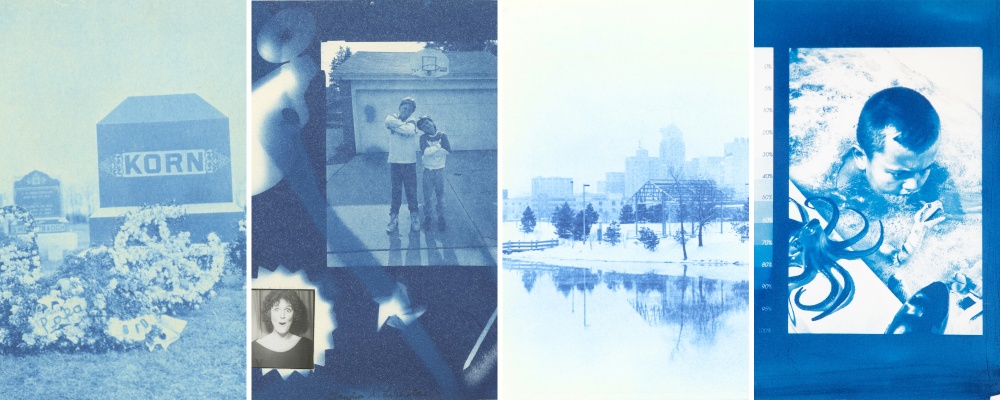
Artist Unknown, Untitled, cyanotype real photo postcard, 2021.33.1309.
Claudia S. Liberatore, Mom, cyanotype, 1992, 2019.48.24.
Claudia S. Liberatore, Riverside (East Lansing), cyanotype,
1982, 2019.48.25.
Athena Marie Placencia, Poseidon, cyanotype, 2010, 2010.27.1.
Cyanotypes are one of the oldest photographic print processes in the history of photography. It is distinctive from other forms of photography because of the resulting shades of blue from its exposure to ultraviolet light. Developed during a time when black and white photography was all that existed, cyanotypes’ versatility, affordability, and color launched this technique into popularity.
Cyanotypes were first introduced by the astronomer, scientist, and botanist John Herschell in 1842. Herschell was searching for a way to easily reproduce his notes and drawings and discovered the cyanotype technique after numerous experiments. This same technique continued to be used to create blueprints, reproductions of architectural and mechanical drawings, and other duplicated records.
After its discovery, botanist, photographer, and friend of Herschell, Anna Atkins, used the cyanotype process to create a photographic book of algae specimens. Her “Photographs of British Algae: Cyanotype Impressions,” published in 1843, became the first book to be photographically printed and illustrated. Her work on this project often designates her as the first well-known female photographer.
The process of creating a cyanotype does not require a dark room or the harmful chemicals often used to process film. It only requires simple, easy-to-find, and safer-to-use chemicals, and UV light, which is readily available by utilizing the sun. To create the image, the cyanotype solution, a mixture of ferric ammonium citrate and potassium ferricyanide, is brushed over paper or other porous surfaces in a dimly lit area. Objects are then placed on top of the paper and exposed to UV light, such as sunlight. A chemical reaction occurs, creating ferric ferrocyanide, which gives the print its blue hue. The last step is to rinse the paper in water. As the print dries, the final product will reveal many shades of blue. The background will be the darkest blue in contrast to the light blue, almost white areas where the paper was covered by an object, or dark areas of the film blocked the UV light.
The images created through the cyanotype are endless. While flowers and botanical items are common, many artists also layer photographic negatives into their images or capture the shadows of glass objects in their prints.
Explore examples of cyanotypes in the GVSU Art Museum Collection!