|
|
|
|
Phone: 616-331-3317 Target Inquiry vanrheej@gvsu.edu 312 Padnos Hall Grand Valley State University Allendale, MI 49401 |
TI Model & Background TI Background Although the National Science Education Standards (NSES) (NRC, 1996) and the Benchmarks (AAAS, 1993) make a compelling case for inquiry instruction, the reality is that most teachers still rely primarily on lecture/discussion instruction with occasional verification laboratory activities (Smith, 2002). This is not surprising, given that traditional college science programs employ primarily lecture and “cookbook” laboratory experiences. As a result of these types of experiences during teacher preparation, teachers’ content knowledge is fragmented and they view science as an objective body of knowledge generated using a linear process, often referred to as the “scientific method” (Abd-El-Khalick & BouJaoude, 1997; Brickhouse, 1990; Gallagher, 1991). In particular, the use of inquiry instructional strategies requires a well developed knowledge of content and pedagogy (Gess-Newsome, 1999; NRC, 1996). Therefore, instructional reform will require changes in teachers’ content knowledge, beliefs and attitudes, and pedagogical knowledge (Anderson, 1996; Borko & Putnam, 1995; Loucks-Horsley & Stiegelbauer, 1991; Phelps & Lee, 2003; Shumba & Glass, 1994). In addition, barriers to inquiry instruction such as lack of access to inquiry materials and assessments (Caton, Brewer, & Brown, 2000; Straits & Wilke, 2002), curriculum constraints (Flick, Keys, Westbrook, Crawford, & Carnes, 1997; Keys & Bryan, 2001; Tretter, 2003), and inadequate in-service education ( One acknowledged mechanism to facilitating the necessary teacher changes and overcoming the barriers to inquiry instruction is teacher professional development (PD). Currently, most PD programs fall short of expectations (AASCU, 2001) and do little to improve teachers’ content knowledge and teaching skills to effectively teach science (NRC, 2001). However, studies have identified several central characteristics of effective high-quality PD programs: duration, collective participation, active learning, coherence, and content-focus (Garet, Porter, Desimone, Birman, & Yoon, 2001). Therefore, a successful PD program for high school science teachers must incorporate these central characteristics; promote change in teachers’ content knowledge, beliefs and attitudes, and pedagogical knowledge; and overcome the barriers to inquiry instruction. One PD experience that has been shown to enhance content knowledge, increase teacher confidence in the use of scientific inquiry, and subsequently, inquiry teaching is the research experience for teachers (RET) (Caton Brewer, & Brown, 2000). RETs have been in place across the country for more than 20 years, with approximately 70 formalized programs in operation. Studies of these programs show positive gains in RET teachers’ attitudes towards science and the use of inquiry-based activities, and that students in classes taught by RET teachers participated in more extra-curricular science activities and achieved higher scores on the NY State Science Regents Exams than students in classes taught by non-RET teachers (SWEPT, n.d; Windschitl 2001; 2002; 2004). However, achievement results from SWEPT are not yet conclusive or generalizable, and the impact of RETs on the quality of inquiry teaching and subsequent effects on student achievement have yet to be examined. Moreover, teachers have difficulty explicitly translating their laboratory research to classroom instruction. Although the deep, connected understanding of science that teachers can obtain through their RET experience is an essential component, clear connections to classroom practice are necessary in effecting instructional change (Gess-Newsome, 2001). The TI PD model is unique because the RET serves as the foundation for adapting instructional materials and evaluating them through action research. Thus, the other core experiences and supporting features of TI are designed to work synergistically with the RET to result in a greater overall impact on teachers and their students by bridging the gap between the research laboratory and the high school classroom. TI Model
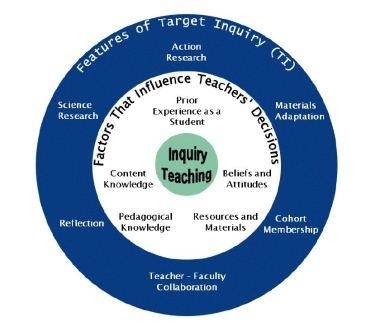
Inquiry is the foundation of teaching and learning and is therefore at the center of the TI model. The features of the TI model are designed to encourage and improve inquiry instruction by impacting teachers’ beliefs and attitudes, and content and pedagogical knowledge, as well as providing adequate resources and materials. The model integrates the core experiences (RET, materials adaptation, action research) with the central characteristics of high-quality PD programs (duration, cohort participation, active learning, coherence, and content-focus (Garet, et al., 2001)) in alignment with the National Science Education Professional Development Standards (NRC, 1996) as shown in model above. Although many teachers associate inquiry with research scientists, the underlying habits of mind by which one actively acquires new knowledge are the same for a scientist in a research laboratory, a student in a science classroom, or a teacher assessing student understanding (Llewellyn, 2005; AAAS, 1993). The RET will allow teachers to further develop habits of mind central to inquiry such as curiosity, persistence, reflection, skepticism, and creativity while gaining firsthand experience in how chemistry research is conducted. However, research has shown that affecting instructional change requires clear connections to classroom practices (Gess-Newsome, 2001), and many teachers have difficulty translating the laboratory research experience to classroom instruction that promotes inquiry habits of mind. Thus, the other core experiences and supporting features of TI are designed to build upon the RET, facilitating connections between the research laboratory and classroom practices, so that teachers can effectively engage their students in authentic inquiry activities. Though inquiry curriculum resources may be available to some teachers, in general, implementation of these materials is largely unsuccessful when teachers feel pressured to adopt new curricula developed by people far removed from their local environments. When teachers do not understand the rationale behind the curricula design or have no say in the adoption process, they are not personally invested in successful curriculum implementation (Cohen, 1995; McLaughlin, 1990; Sprinthall, Reiman, & Thies-Sprinthall, 1996). As such, teachers often find ways to adapt the new materials to fit into their current instructional practices, often undermining the intended benefits to student learning embedded in new curricula. Additionally, teachers are more likely to implement and sustain incremental changes than large-scale reforms. Incremental changes result in greater teacher satisfaction, allowing them to improve their instructional practice by making important changes to aspects of their teaching while retaining effective elements of their instructional repertoire (Huberman, 1992; Knapp, 1997; Louis, Marks, & Kruse, 1996; McLaughlin, 1990). Consequently, the TI model combines the RET with guided materials adaptations to ensure that teachers are personally invested in the adaptations and that the adaptations foster inquiry instruction. During the materials adaptation, teachers will be supported as they draw upon their research experience to make appropriate modifications to existing materials to more accurately model how science is done and positively impact student learning in their classrooms. This will ensure that the teachers are both personally invested and comfortable with the use of the new inquiry materials. Finally, to affect sustainable instructional change, teachers’ beliefs about teaching and learning must be examined and challenged. This requires teachers to reflect on the connections between their research experiences, their classroom practices, and the education literature. As teachers view learning from their classrooms as more important than learning from outside experts (Smylie, 1989), reflection that focuses on classroom practices and student learning is critical. Thus, another central piece of the TI model is reflection. Informal reflection activities are incorporated throughout the program allowing teachers to make sense of and connect their research experiences to classroom practice. In addition, teachers will conduct an action research project in their classrooms, allowing for formal reflection concerning the effectiveness of their instruction. The literature indicates that action research can positively impact teacher attitudes towards inquiry instruction, facilitate the implementation of innovative teaching methods or materials, and improve teaching and learning (Bencze & Hodson, 1999; Berlin, 1996). Moreover, through the action research project teachers will make connections between the inquiry process and teaching. Teachers will once again engage in the inquiry process as they collect and analyze data to answer their questions about student learning and reflect on these findings to deepen their understanding of student learning and inform changes in their instructional approaches. The TI model is translated into seven graduate chemistry education courses to be taken over three years, with a majority of work to be carried out over three summers. See TI Courses for more information. Abd-El-Khalick F. & BouJaoude, S. (1997). An exploratory study of the disciplinary knowledge of science teachers. In I. P. Rubba, P. Keig, & J. Reys (Eds.), Proceedings of the 1997 Annual International Conference of the Association for the Education of Science Teachers (pp. 89-133). Berlin, D. (1996, April). Teacher action reserach: The impact of inquiry on curriculum improvement and professional development. Paper presented at the annual meeting of the American Educational Research Association, New York, NY. Borko, H. & Putnam, R. (1995). Expanding a teacher’s knowledge base: A cognitive psychological perspective on professional development. In T. Guskey & M. Huberman (Eds.), Professional development in education: New paradigms and practice (pp. 35-61). NY: Teachers College Press. Brickhouse, N. W. (1990). Teachers' beliefs about the nature of science and their relationship to classroom practice. Journal of Teacher Education, 41, 52-62. National Research Council (2001). Educating teachers of science, mathematics and technology. |
| Last Modified Date: October 23, 2007 | |
| Copyright © 1995 - 2009 | Grand Valley State University is an Equal Opportunity/Affirmative Action Institution |