Kutsche Office of Local History

Kutsche Office Local History Research Grants
The Kutsche Office of Local History can provide funds to assist Grand Valley faculty and community researchers to conduct research that focuses on marginalized ethnic and social groups in Kent, Ottawa, Muskegon and Allegan Counties. Five to ten research grants ranging from $500 to $1000 can be awarded. All tenure-track, visiting and affiliate faculty and approved community researchers are eligible to apply for a research grant.
Applied scholarship and creative efforts that address issues pertinent to marginalized ethnic and social groups may also be considered, such as performances, exhibitions, documentary films, artifact preservation, records management, oral history interviews etc.
Priority will be given to research and scholarly projects that include Grand Valley student participation and projects that solicit input from members of the underrepresented group to be studied in the design and implementation of the research project.
Application Process
CLICK HERE to apply online. The deadline for applications is January 9, 2012.
The Kutsche Office of Local History can provide funds to assist Grand Valley faculty and community researchers to conduct research that focuses on marginalized ethnic and social groups in Kent, Ottawa, Muskegon and Allegan Counties. Five to ten research grants ranging from $500 to $1000 can be awarded. All tenure-track, visiting and affiliate faculty and approved community researchers are eligible to apply for a research grant.
Applied scholarship and creative efforts that address issues pertinent to marginalized ethnic and social groups may also be considered, such as performances, exhibitions, documentary films, artifact preservation, records management, oral history interviews etc.
Priority will be given to research and scholarly projects that include Grand Valley student participation and projects that solicit input from members of the underrepresented group to be studied in the design and implementation of the research project.
Application Process
CLICK HERE to apply online. The deadline for applications is January 9, 2012.
Kutsche office awards grant

Veta Tucker, director of the Kutsche Office of Local History, recently awarded a grant from the office to a research team working on an exhibit for the Michigan Women’s Hall of Fame.
Excerpted from a feature story in the Fall 2011 issue of Grand Valley Magazine. Read more at www.gvsu.edu/gvmagazine.
Sherry Johnson, assistant professor of English whose scholarship focuses on Black women and African American literature, received a mini-grant to collaborate with Sonya Bernard Hollins, an African American journalist and community researcher from Kalamazoo. Hollins had spent years gathering details on the life of Merz Tate, who grew up on a farm in Mecosta County, was the first African American Distinguished Alumna from Western Michigan University, the first African American woman to earn a doctorate from Oxford University, and later served in the U.S. Department of State. Grand Valley students from the Department of Art & Design mounted about 50 digital photographs that were included in the Tate exhibit displayed at the Michigan Women’s Hall of Fame in Lansing in April 2011. Students in Tucker’s Black Women’s History class created a passport to guide visitors through the exhibit.
Barbara Roos, associate professor of film & video production in the School of Communications, is the recent recipient of a Kutsche min-grant. Roos said the goal of her project is to share information about the existence of a strong, nationally known activist feminist movement in West Michigan during the era of the 1970s.
“‘Why West Michigan of all places?’ is one of the issues we explore,” she said. “Another is the relevance of the evolution of this one locally grounded movement and its spinoffs to the 21st century. One such spinoff was the Aradia project that brought community and Grand Valley women together to share information and resources. The cross-colleges class “Women, World and Wonder” is an example of an academic project that had broad and lasting influence.”
Ann Filmyr, academic dean of the College at the Institute of American Indian Arts in Santa Fe, and a 1978 graduate of Grand Valley’s Thomas Jefferson College, is one of the seven interviewees recorded so far. She characterizes the period when she was a student as building a “cultural feminism,” through the creation of alternative organizations run by women for women, and that the local movement networked nationally with a feminist movement that was gaining enormous momentum in the mid-to-late 70s.
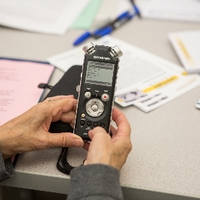
With the generous help of Grand Valley archivist Nancy Richards, searches of the Seidman House Special Collections has located materials relevant to local feminist activities starting almost immediately after the founding of TJC in 1970-71. Former TJC/GVSC faculty member Jere VanSyoch has permitted use of films she shot locally in the 1970s, which she subsequently edited into a DVD titled “The Brothel, The Temple and Art.”
Roos said the project will share these materials in three ways: as an academic article, as a short informational DVD, and on a website. “Website users will be able to search and select from the collection to meet their personal needs,” said Roos. “We hope to include a feature that allows users to comment, thus making the project in part open-ended and process-oriented.”
Sherry Johnson, assistant professor of English whose scholarship focuses on Black women and African American literature, received a mini-grant to collaborate with Sonya Bernard Hollins, an African American journalist and community researcher from Kalamazoo. Hollins had spent years gathering details on the life of Merz Tate, who grew up on a farm in Mecosta County, was the first African American Distinguished Alumna from Western Michigan University, the first African American woman to earn a doctorate from Oxford University, and later served in the U.S. Department of State. Grand Valley students from the Department of Art & Design mounted about 50 digital photographs that were included in the Tate exhibit displayed at the Michigan Women’s Hall of Fame in Lansing in April 2011. Students in Tucker’s Black Women’s History class created a passport to guide visitors through the exhibit.
Barbara Roos, associate professor of film & video production in the School of Communications, is the recent recipient of a Kutsche min-grant. Roos said the goal of her project is to share information about the existence of a strong, nationally known activist feminist movement in West Michigan during the era of the 1970s.
“‘Why West Michigan of all places?’ is one of the issues we explore,” she said. “Another is the relevance of the evolution of this one locally grounded movement and its spinoffs to the 21st century. One such spinoff was the Aradia project that brought community and Grand Valley women together to share information and resources. The cross-colleges class “Women, World and Wonder” is an example of an academic project that had broad and lasting influence.”
Ann Filmyr, academic dean of the College at the Institute of American Indian Arts in Santa Fe, and a 1978 graduate of Grand Valley’s Thomas Jefferson College, is one of the seven interviewees recorded so far. She characterizes the period when she was a student as building a “cultural feminism,” through the creation of alternative organizations run by women for women, and that the local movement networked nationally with a feminist movement that was gaining enormous momentum in the mid-to-late 70s.
With the generous help of Grand Valley archivist Nancy Richards, searches of the Seidman House Special Collections has located materials relevant to local feminist activities starting almost immediately after the founding of TJC in 1970-71. Former TJC/GVSC faculty member Jere VanSyoch has permitted use of films she shot locally in the 1970s, which she subsequently edited into a DVD titled “The Brothel, The Temple and Art.”
Roos said the project will share these materials in three ways: as an academic article, as a short informational DVD, and on a website. “Website users will be able to search and select from the collection to meet their personal needs,” said Roos. “We hope to include a feature that allows users to comment, thus making the project in part open-ended and process-oriented.”
“If a community group has a project that fits with our mission, we can help them bring it to reality.”
The Kutsche Office helped fund a book project, A New Home in Michigan, which tells the story of Mexican Americans who migrated to Muskegon prior to World War II. “That project started with oral histories and we provided seed money for them to publish a book,” Tucker said. “If a community group has a project that fits with our mission, we can help them bring it to reality.”
In April 2011 the office hosted its second forum for local historians from public museums, historical and genealogical societies, local libraries and other organizations. Museum 101 sessions were held in March, April and May 2011 to help volunteers understand the basics of artifact preservation and archive collection. The workshops were open to Grand Valley students who are interested in museum careers; visit the website www.gvsu.edu/kutsche for details.