
Water Temperature
How is water temperature measured on the vessels?
Usually water temperature is measured on the vessels using thermometers that are mounted on the sampling bottles. The thermometers on the sampling bottles must be read immediately after the bottles are retrieved. Temperature is recorded in degrees Celsius (°C). The Celsius scale (once called the centigrade scale) uses the freezing (°0) and boiling (°100) points of water as the basis of the scale. The conversion from degrees Fahrenheit to degrees Celsius is found in Table 2. Another device for obtaining temperature profiles is a "fish finder" data logger that is attached to the line on the PONAR sampler.
On the day of a cruise, one can get an indication of the surface water temperature on Lake Michigan by querying the Michigan Sea Grant Coast Watch site. This site can be found at https://www.coastwatch.msu.edu/michigan/m41.html. An example of the surface temperature data is found in Figure 9, which is based on information from the Coast Watch Internet Site.
What is the significance of temperature data?
Several interesting studies can be made from the data obtained from the temperature readings. Most prominent is the identification of temperature patterns at various depths and the relationship to the seasons of the year ( Figure 10). Stratification refers to distinct layers of water that do not mix with each other due to density differences.
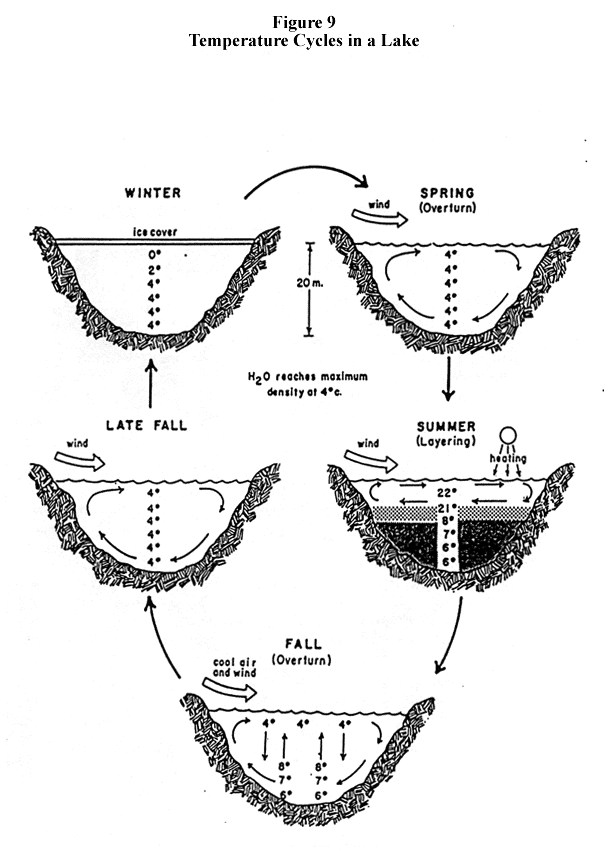
The temperature readings also give an indication of whether conditions are favorable for cold-water fishes. The rates of metabolism of animals, as well as rates of photosynthesis and decomposition, are temperature sensitive. The migration of fish and their spawning behavior are associated with temperature changes. Temperature and dissolved oxygen are related in that warmer water holds less oxygen than cooler water.
How does the lake temperature vary throughout the year?
In most inland lakes in the temperate zone, the temperature of the lake is essentially uniform from top to bottom two times per year, spring and late fall. When this occurs, wave action on the surface will mix oxygen in the air with the water and the oxygen-rich water is driven down to lower depths. The bottom oxygen-poor water will be brought to the surface where it can be replenished with oxygen. Since this occurs twice per year in spring and fall, these lakes are said to be dimictic; di meaning two and mictic meaning to mix. Turnover is not uniform in a lake and strong winds can cause upwellings where nutrient rich deep water moves towards the surface.
At other times of the year, the water temperature of a large body of water like Lake Michigan can be understood by looking at how the density of water is related to temperature. Water freezes at 0°C (32°F) but it has its greatest density at 4°C (39.2°F). Less dense water will float on top of dense water, that is, water colder or warmer than about 4°C will float.
During winter, temperate zone lakes generally achieve a relatively uniform temperature from surface to bottom with slightly colder water near the surface. Once covered with ice, the water just beneath the ice is slightly above the freezing point, and increases to no more than 4°C (the temperature of maximum density) towards the bottom of the lake. It is because of the direct relationship between water temperature and density that ice floats on the surface of a lake. The ice layer provides protection from mixing of water by wind, inhibits diffusion of oxygen, and if the ice is covered with snow, then the transmission of light into the water below. The fact that the density of water is greatest at 3.98° C and not zero prevents lakes from freezing from the bottom up to the surface.
The relationship between water temperature and density also plays a determining role in lake conditions during the summer. Remember that above about 4°C, the water density decreases and this warmer, lighter water floats on colder, heavier water. Hence, as heat from the sun increases during the summer, the upper waters of the lake become warmer and lighter than deeper waters. The energy of the wind is inadequate to mix the upper water with the colder, more dense, deeper water. This situation leads to a summer stratification period with the warmer water separated from the deeper, much colder, bottom water ( Figure 10).
In the summer, lakes show thermal stratification, which means that there are distinct layers defined by temperature. When stratification occurs, the different layers are given names to identify their location. Warm water is found in the top layer (epilimnion) followed by a deeper layer where there is a drastic temperature drop of about 1ºC per meter. This is the thermocline; the major thermocline located between the epilimnion and the hypolimnion is called the metalimnion. Colder, heavier water is found in the bottom layer (hypolimnion).
One very important consequence of summer stratification of a lake is that circulation due to wind action is largely confined to the upper water mass known as the epilimnion. Because the lower water mass is isolated from the atmosphere and receives little, if any, sunlight, dissolved oxygen is not replenished in this water mass. The dissolved oxygen may diminish to such a level that it limits aquatic life. However, oxygen will be replenished at the end of summer when water temperatures become more uniform and the wind circulates all of the water in the lake basin.
Some lakes in the temperate zone may not be dimictic because they are either very large, like Lake Michigan, or very shallow, like Spring Lake. Lake Michigan experiences summer stratification similar to what is described above, but early in the summer the stratification begins near shore and works its way toward the middle of the lake as the summer progresses. The outer most end of this stratification is called a thermal bar. The thermal bar can be found where the surface temperature of the lake is at 3.98° C (this water mass is continuously sinking and acts like a barrier between the nearshore and offshore waters); surface water farther offshore will be colder, and closer to shore will be warmer. Eventually, the stratification process that began around all of the shoreline will meet in the middle of the lake and the lake will be stratified completely (as described above).
The difference between Lake Michigan and smaller lakes in the temperate zone lies in the fact that, since satellite imagery has been available, it has never completely frozen across (over 90% has frozen, but this is rare). Instead of the system starting fall turn over and eventually freezing to stop the turnover process, it continues to turn over all winter long right into spring turnover. Therefore, the system really only turns over once per year; it just lasts from fall to spring!
Instead of referring to Lake Michigan as a dimictic lake, we say that it is warm monomictic. This certainly does not suggest that the system is warm. We just divide monomictic into two categories, cold and warm. If the system only mixes once per year during the summer because it is frozen most of the year (like in the sub-arctic zone), then we call it cold monomictic. If the system never freezes completely, then we call it warm monomictic.
A lake like Spring Lake is a different story. Spring Lakes shallow system freezes over completely so we may think that it is dimictic. However, because it is shallow and a riverine system, the stratification breaks down several times throughout the summer. Every time this happens, the lake turns over. Since it mixes many times per year, we call it polymictic..