
Research  

Herbert Hoover's Bad Press

By George H. Nash

Often it seems that Herbert Hoover is the Rodney Dangerfield of American politics: he gets no respect.

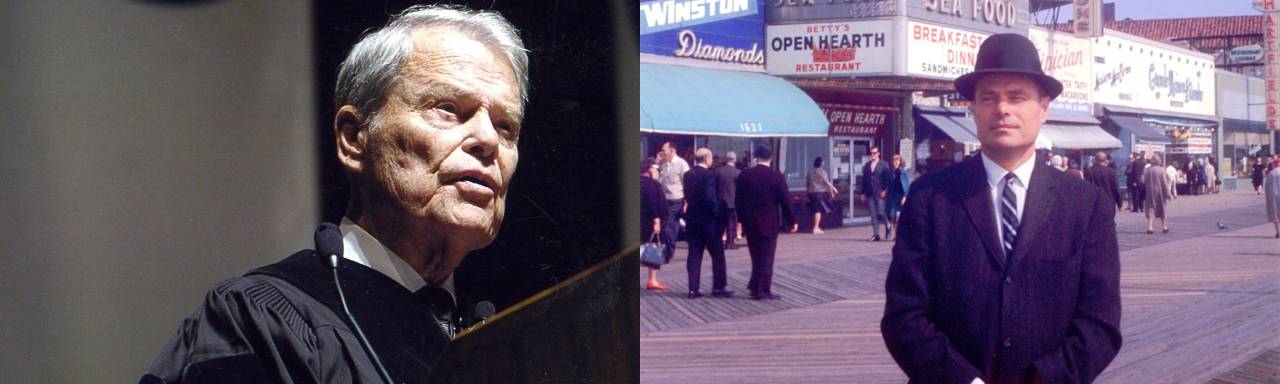
George H. Nash

Other unpopular Presidents, like Woodrow Wilson and Harry Truman, have recovered their reputations posthumously. A few, like Ronald Reagan, have lived to see their ratings rise. Some Presidents whom historians deem mediocre -- like Grover Cleveland and William Howard Taft -- are conceded in retrospect to have possessed commendable integrity.

But not Hoover -- at least not in our media and political culture of 2004.

Consider the evidence. A couple of months ago a caravan of 51 unemployed Americans descended on the Herbert Hoover Presidential Library-Museum in West Branch, Iowa. They were part of a national "Show Us the Jobs" tour organized by the AFL-CIO. Upon reaching the Hoover Library grounds, the travelers disembarked from their buses, lined up near the museum entrance, unfurled a "Show Us the Jobs" banner, and had themselves photographed.

Why did they stop in West Branch? Because, explained one of the organizers, "George Bush is the first President since Herbert Hoover to have a net job loss." "We're just here," she said, "to acknowledge Herbert Hoover."

Acknowledgement, indeed. The tour group did not bother to visit his museum. Having staged their "photo op," the unemployed reboarded their buses and moved on. Their stay in West Branch lasted just twelve minutes.

The "Show Us the Jobs" media event is emblematic of the use to which Hoover's name is being put in this election year. Across the land political opponents of President Bush are reciting the mantra that he is "the first President to lose jobs since Herbert Hoover and the Great Depression." Whatever one may think about the statistical basis for this charge, the intention of Bush's critics is clear: to tie him rhetorically to a man perceived by the critics to have been a presidential failure.

Even the state of Iowa -- where Hoover is something of a hero and his historic site a popular tourist attraction -- has not been immune from the current wave of Hoover-bashing. Recently the governor himself joined in the refrain that the Bush administration has "the worst job creation record since Herbert Hoover." And at the state capitol in Des Moines, a portrait of Hoover that had long hung in the governor's office has now been tucked away in a closet. The portrait is said to be "in need of repair."

What is happening here? Why is Hoover suffering once again from a bad press? At one level the answer is obvious. Like consumer confidence data and the monthly unemployment rate, Hoover has become a leading economic indicator. Whenever the economy falters, the mention of his name shoots up. Nearly forty years after his death and more than seventy years after his presidency, he remains a historical punching bag, a symbol of hard times, ineptitude, and indifference.

The development of this symbolism was not exactly accidental. During Hoover's administration the Democratic Party's chief publicist and spinmeister, Charles Michelson, orchestrated an unremitting barrage of disparagement of Hoover's shortcomings: a foretaste of what a later generation would call "the politics of personal destruction." As the economy worsened, the nation's travails were increasingly personalized. Millions of bewildered Americans looked for scapegoats, and Hoover became the target. It was not the Great Depression; it was the "Hoover Depression." Shantytowns of the homeless were named Hoovervilles. The insides of trouser pockets were called "Hoover handkerchiefs." Newspapers were "Hoover blankets." Armadillos were "Hoover hogs."

The temptation to interpret the Depression as a giant morality play, replete with heroes and knaves, did not abate when Hoover left office. Franklin Roosevelt -- whose grasp of economics was not profound -- perceived the world in such judgmental terms. In his 1933 inaugural address he roundly denounced the nation's "money changers" as the villains in the drama and vowed to restore "the temple of our civilization" to "the ancient truths." Later on he castigated "economic royalists" and pledged to make himself their "master."

For years to come, at election time, Roosevelt and his Democratic successors "ran against Hoover." In 1948 President Harry Truman (who privately admired Hoover) nevertheless lambasted him on the hustings. If the Republicans won the election, he claimed, it would bring back the era of the "Hoover cart" -- "the remains of the old tin lizzie being pulled by a mule, because you couldn't afford to buy a new car [and] you couldn't afford to buy gas for the old one." The "Hoover cart," said Truman, was "the only automobile in the world that eats oats."

And so it goes whenever the economy weakens. In 1987, when the stock market suddenly plummeted, allusions to Hoover and the Crash of 1929 filled the airwaves, and films of Depression-era breadlines appeared on television. In 1992, when President George Herbert Walker Bush ran for reelection at the end of a recession, leading Democrats ridiculed him as George Herbert Hoover Walker Bush. Old habits among politicians die hard.

Today's critics of Hoover on the Left, then, are heirs to a long and by now reflexive tradition of political oratory. To them he is little more than an advertising slogan, a Pavlovian stimulus meant to elicit an emotional response. Hoover/Depression, Hoover/unemployment, Hoover/Republicans: it is pro-New Deal historiography reduced to a single catchword.

But if Hoover wins little respect these days among partisan Democrats, where are his defenders among the Republicans? The answer is: almost nowhere, and therein lies another curious tale.

During Hoover's long and productive ex-presidency he came to be revered by many in the GOP. His philippics against the New Deal inspired the party faithful. His speeches at national conventions were received with rapture. A patron of Human Events, The Freeman, and other conservative causes, he was admired as a benevolent grandfather figure on the American Right. To his liberal opponents and a considerable number of voters, his name continued to connote hard times and ineffective leadership. To his conservative supporters it conveyed an image of resilient rectitude.

When Hoover died in 1964, however, his political comeback died with him, and within a decade-and-a-half his image radically changed. Acclaimed in his later years as "the greatest Republican of his generation," by the 1980s he was likened on the Right to Jimmy Carter. When Ronald Reagan became President in 1981, one of his first acts was to hang a portrait of Calvin Coolidge in a prominent place in the White House. During his presidency Reagan was known to quote Franklin Roosevelt (but not Hoover) in his speeches. Reagan himself was not publicly critical of his predecessor. But among a rising generation of conservative pundits and politicians, Hoover fell completely from favor.

What happened? In the 1970s a new conservative orthodoxy known as supply-side economics was born. Led by the free market economist Arthur Laffer, the writer Jude Wanniski, Representative Jack Kemp, and the editorial board of the Wall Street Journal, the supply-siders built a powerful case for the reduction of tax rates as the answer to the oppressive stagflation of the Nixon/Ford/Carter years. Their arguments became the intellectual foundation for the Reagan Revolution and the dominant economic paradigm of the Republican Party ever since.

Searching for historical precedents to buttress their policy agenda, the supply-siders extolled the tax-cutting program of Calvin Coolidge and Secretary of the Treasury Andrew Mellon in the 1920s, as well as the tax cuts propounded by John F. Kennedy forty years later. Significantly, they did not turn in the least to Herbert Hoover. In the eyes of the evangelical supply-siders, President Hoover had committed two disastrous blunders. First, in 1930 he had signed into law the Smoot-Hawley tariff, a protectionist measure which (in their view) fractured the world economy and converted the crisis of 1929 into a catastrophe. Second, in 1931-1932 Hoover had proposed -- and a Democratic-controlled Congress had enacted -- a massive tax increase in a desperate effort to balance the federal budget. It was the largest percentage peacetime tax hike in American history. It was a precedent which naturally did not appeal to conservative Reaganites of the 1980s and 1990s.

And that was it. Supply-side theorists and publicists showed little interest in any other part of Hoover's record: his belief in voluntarism, for example, or his social philosophy grounded in the ideal of equal opportunity. Nor did they pay much attention to the historical context in which his presidential decisions occurred. In fiscal year 1932, for instance, the federal government incurred its largest peacetime deficit to date in American history, a shortfall which approached a staggering 60% of all federal expenditures. Faced with a peacetime fiscal drain of unprecedented proportions, what were President Hoover and the Congress to do? The financial stability of the federal government and the viability of the gold standard appeared to hang in the balance. In 1932 no one of influence advocated tax cuts under these dire circumstances. Even after the tax hike of 1932 became law, the tax rates remained astonishingly low by modern standards. The vast majority of the American people still paid no federal income taxes whatsoever.

For present-minded activists of the 1980s and 1990s, however, Hoover's overall record of public service seemed less important than the alleged effects of his tax and tariff policies. Like the do-nothing Hoover of liberal caricature, the Hoover of supply-side economic orthodoxy became a cardboard figure -- a rhetorical weapon to deploy against political foes. In an ironic reversal, it was now Republicans who accused protectionist, high-tax Democrats of repeating Hoover's errors.

To Jack Kemp and other popularizers of the new doctrine, Hoover was synonymous with dour, fetishistic, old-fashioned, balance-the-budget conservatism: a shopworn and defensive ideology which they hoped to expel from the Republican Party. Time and again Kemp contrasted his optimistic brand of Republicanism with what he derisively called "Hooverism."

The rise of supply-side economics -- and the anti-Hoover history lesson associated with it -- was part of a larger intellectual trend which has gathered steam since the 1970s: the proliferation of scholarly, libertarian critiques of the liberal welfare state and its antecedents. At first one might think that Hoover, the arch-critic of New Dealism from 1933 to 1964, would be hailed in this new literature as a libertarian prophet, now that the currents of history have turned his way. It has not happened. In the world of free-market economists, historians, and think tanks, it is not Hoover the ex-President who commands attention, but Hoover the President, and they do not particularly like what they see. If to today's liberals Hoover in the White House was a timid man who did too little, to today's libertarians and many conservatives he was an unwise activist who did too much. In recent books of a libertarian cast like Jim Powell's FDR's Folly, Hoover emerges not so much as Franklin Roosevelt's antithesis but as his wrong-headed progenitor: a well-meaning interventionist who paved the way for the even more egregious statism which followed.

Thus even in what might be considered his natural constituency, Hoover has become a political outcast, whose name is rarely invoked except in criticism. Among libertarian thinkers and those influenced by their scholarship (a large chunk of the contemporary American Right), he tends to be perceived not as one of "us" but as one of "them."

There are additional reasons why Hoover continues to receive a bad press -- and, all too often, no press at all. We live in a media world driven by sound bytes, an environment not conducive to the nuanced analysis that Hoover requires. There remains a disconnect between recent Hoover scholarship -- which tends to portray him as an exceptionally able and even tragic figure -- and the selective, moralistic stereotyping so ingrained in our popular culture. Moreover, the narration of our nation's political history is increasingly organized around the presidency -- a narrowing of focus that, in Hoover's case, omits much of importance. He was, after all, in public life for fifty years, of which only four were in the White House. In this era of perpetual campaigning for the presidency, Hoover's enormous non-presidential achievements -- notably his humanitarian relief work and creation of the Hoover Institution -- are repeatedly overlooked. In the popular imagination all that seems to matter is his presidency.

Finally, Hoover continues to receive less respect than he ought because, throughout his amazingly varied public life, he often did not fit the conventional mold. At the outset of his career in politics he called himself an "independent Progressive," alienated from Democratic radicals and Republican reactionaries alike. Toward its end he supported Barry Goldwater for President. A self-styled Progressive Republican in the 1920s, distrusted by the party's conservative wing, he conceived his White House term as a reform presidency -- until Franklin Roosevelt and others outflanked him on the Left. A trenchant opponent of New Deal "collectivism," he labeled his own creed "historic liberalism," which must, he admitted, be "conservatism in contrast." He was a friend of Woodrow Wilson -- and Douglas MacArthur, of Justice Louis Brandeis -- and Senator Joseph McCarthy. He hated Communism but fed millions of starving Russians under the Bolshevik regime. He loathed socialism yet favored stiff inheritance taxes on large fortunes. His political philosophy combined both conservative and liberal elements.

In short, Hoover was difficult to pigeonhole -- "too progressive for the conservatives," it has been said, "and too conservative for the radicals." In today's increasingly polarized political climate, he is not a convenient candidate for anyone's hall of heroes.

Must those who honor Hoover's legacy resign themselves, then, to his present status as a political pariah? Not entirely. As the economy recovers, derogatory references to him will not doubt decline in frequency -- until the next downturn. In one respect, in fact, time is subtly working in Hoover's favor. A recent poll conducted by the University of Pennsylvania's National Annenberg Election Survey found that only 43% of the nation's adults could correctly identify him. Among respondents between the ages of 18 and 29, the figure fell to 38%. Most Americans, it seems, do not know who Hoover was, and the younger they are, the less they know, good or bad. Thus the current spate of aspersions about him in the media, while irritating to Hoover's defenders, is probably relatively harmless.

But for those of us engaged in historical scholarship and the propagation of historical knowledge, the rising tide of historical ignorance and amnesia is hardly a solution. It does, however, offer an opportunity to fill in the blanks in the public consciousness of Hoover's record.

But how? One strategy -- embedded in the programs of the Hoover Library-Museum -- is to call attention to the extraordinary range of Hoover's achievements both before and after his troubled presidency. It is an approach worth building upon. From time to time I lecture about Hoover to audiences around the country. Afterward people invariably say that they had no idea how truly accomplished he was. They had no idea, for instance, that in his farflung humanitarian endeavors he was responsible for saving more lives than any person who has ever lived. The non-political and non-presidential parts of the Hoover legacy remain, for most of the public, terra incognita.

A strategy of "accentuating the positive," however, will not be enough by itself. As someone once remarked, our problem is not what we don't know; it's what we do know that isn't so. Paeans to Hoover's humanitarianism ("the rest of the story") will not much impress those who insist that his actions as President exacerbated and failed to mitigate the Great Depression. If advocates of a "better press" for Hoover wish to make headway, they must reappraise the policies of his presidency.

And here fresh questions abound for serious scholars. How much of what we "know" about President Hoover isn't so? How much of it is simply unexamined mythology? What, for instance, was his role in the political battle that produced the Smoot-Hawley tariff? And was the tariff as deleterious as later alleged? (Some recent scholarship on the subject raises doubts.) Was the tax increase of 1932 as much of a mistake as its detractors contend? And how do Hoover's anti-Depression measures compare with his successor's? At a juncture when the scholarly literature on Roosevelt's economic performance is increasingly critical, the time has surely come for a reassessment of Hoover's.

And by what criteria should he then be judged? On what grounds may he properly be criticized: for intervening in the economic crisis too little, or for intervening too often and too much? It is a question with profound implications for our national self-understanding and public policy. What, in short, is the lesson of the Hoover presidency? The answer is no longer self-evident.

The time has also come for a full-length documentary film about Hoover's life. In a culture dominated more than ever by images, we need a movie that truly communicates the high achievements and ironies of his long career.

There is much, then, to be done if Hoover is to appear as more than a negative blip on our national radar screen. For starters, why not indulge in a bit of theater suitable for our times? Why not invite the busload of unemployed back to West Branch -- and bring in the media to cover the story?

But let the story be this. Have the visitors spend a day inside the Hoover museum, instead of a mere twelve minutes on the front lawn.


This essay appeared in the Spring 2004 issue of "The American Road," the newsletter of the Hoover Presidential Library Association.

Site Index  | Printer Friendly

  Copyright © 1995 - 2006 Grand Valley State University is an Equal Opportunity/Affirmative Action Institution 

Last updated: November 19, 2009, 9:10 AM        Page Views: 22,990,954

Copyright Notice: The Hauenstein Center for Presidential Studies is a non-profit organization that serves to encourage study, reflection, and discussion of the U.S. presidency. All documents, quotations, links, book reviews, movie reviews, illustrations, photographs, tables, and essays are posted for the benefit of visitors to this site. Permission to use the Web-based resources of the Hauenstein Center is hereby granted, provided that full attribution -- including URL address -- is given.