Academic Programs • Print this Brochure
Occupational Therapy, M.S.
Subject Overview
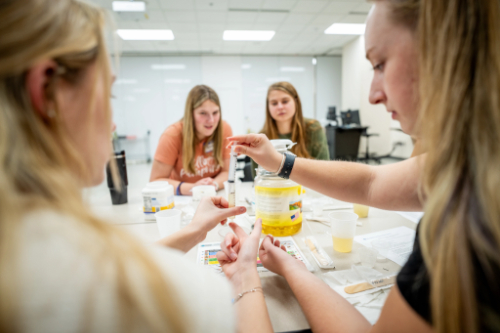
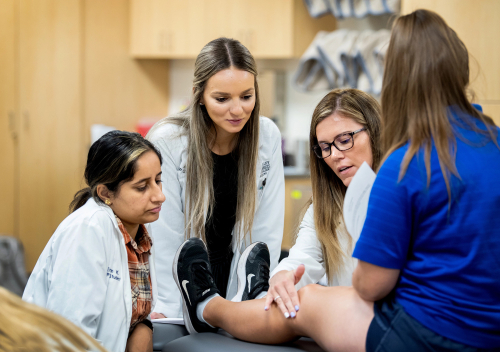
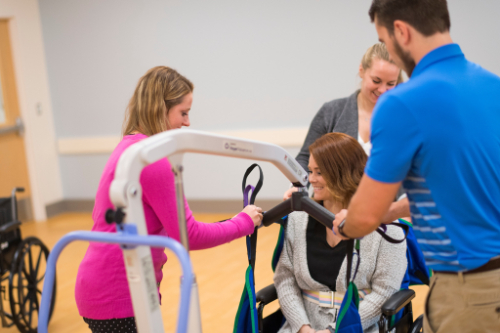
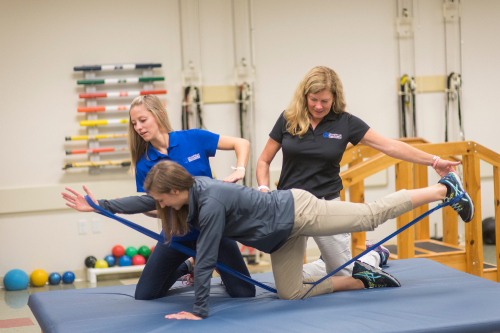
The occupational therapy profession is based on the belief that purposeful and meaningful activities, called "occupations," are the primary tools used for human development (AOTA, 1979). Furthermore, the use of occupation - everyday activities - as a treatment method is occupational therapy's unique and defining contribution to health care. Occupational therapists work with clients who have physical or mental disabilities, as well as healthy older adults to improve independence in day-to-day functional activities.
Program Description
The occupational therapy program at Grand Valley State University is a two-year curriculum leading to an entry-level Master of Science (M.S.) degree. Candidates for the occupational therapy program must have an undergraduate degree and have completed all of the required preprofessional coursework, including courses in the natural, health, and social sciences. The occupational therapy curriculum is built around the concept of occupation as the core knowledge base in the field, and the base upon which all occupational therapy intervention is developed. The curriculum is designed to produce professional practitioners and socially conscious citizens who appreciate the unique perspective of individuals and the cultures that influence them, value a democratic perspective of health care and social services delivery, and apply problem-solving, critical thinking, and lifelong learning toward meeting the needs of society.
Admission to the occupational therapy program is competitive. Maximum class size is 30. The candidates are ranked on a total score basis, and the top 30 candidates (minus early admits from CMU and Hope; and deferrals) are sent a letter offering them seats in the Program. The balance of candidates over 30 are considered alternates for admission and are ranked according to total score. Candidates may submit applications to the occupational therapy program in the year that they attain senior status. Admission decisions will be made in the first and second semesters of the calendar year.
Admission to the occupational therapy program first requires completion of the Grand Valley State University graduate application, regardless of previous college attended. Candidates must expect to complete all preprofessional and undergraduate work prior to entering the program. Applications may be obtained from the admissions office on the Allendale campus or from the College of Health Professions' office, room 200 in the Cook-DeVos Center for the Health Sciences in downtown Grand Rapids, or online. The program requires that all application materials be fully completed including:

a) the volunteer experience form(s);
b) the prerequisite completion form;
c) the two letters of recommendation forms;
d) the achievement summary form; and
e) official transcripts from all colleges/universities attended.
The completed application materials must be admitted to the Admissions Office no later than January 15 of the calendar year of desired admission. After January 15, applications will be accepted on a first-come, first-served basis, according to postmark date and these candidates will then be considered and accepted, on a rolling basis, until the prospective class is filled.
Academic achievement requires a minimum 3.0 grade point average in preprofessional courses and a 3.0 grade point average in the last 60 credit hours of academic course work. All preprofessional courses must be completed with a grade of "C" or better. Students accepted into the occupational therapy program must have a completed baccalaureate degree from an accredited institution of higher education.
Career Opportunities
After graduation, employment is available in a variety of settings with a broad range of ages and disabilities. Estimated to be one of the fastest growing occupations by the Federal Bureau of Labor Statistics (2006), growth in occupational therapy is expected to be 34 percent between 2004 and 2014. This expected growth is due to an increasing need for rehabilitation among all age groups, particularly for the growing older adult population, and for children with disabilities. Common settings for occupational therapists include hospitals, school systems, private practices, mental health and adult day care programs, residential facilities, work rehabilitation, and community agencies.
Degree Requirements
Completion of 77 to 80 credits in the professional curriculum is required for completion of the master's degree in occupational therapy. General graduate academic policies and regulations can be found in the Grand Valley State University Undergraduate and Graduate Catalog. General university degree requirements are in the Academic Regulations section of the catalog, and the requirements for undergraduate majors are in the appropriate Academic Program section. The catalog can be found online at www.gvsu.edu/catalog.
In this program, effective communication is emphasized, including academic writing, appropriate to the discipline, as well as the ability to effectively collaborate with other students. Each student is required to perform independent work with appropriate academic citation when the work of others is used. Students need to spend at least 40 hours per week on academic activities including going to class, doing homework, preparing for exams, reading, and working on semester-long projects.
The program requires that students attain a minimum of 84 percent competency in each course, and in each module of each course. This requirement is reflected in each course syllabus across the professional curriculum. Refer to the online catalog for course requirements.

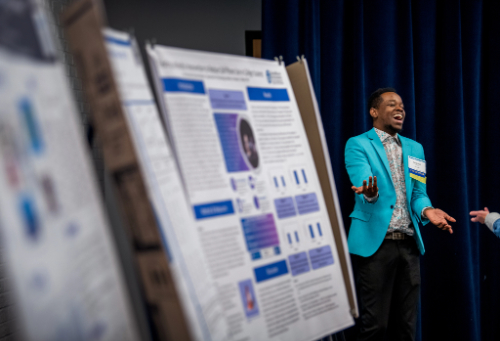
Grand Valley offers research opportunities to all graduate students. Some students will collaborate with faculty on ongoing research projects and other students will find or create research opportunities independently.
For courses, curriculum, other degree related information, and faculty listings, please visit the Grand Valley State University catalog online at www.gvsu.edu/catalog.
For More Information
Cynthia Grapczynski, Ed. D., O.T.R. Director
Occupational Therapy Program
College of Health Professions
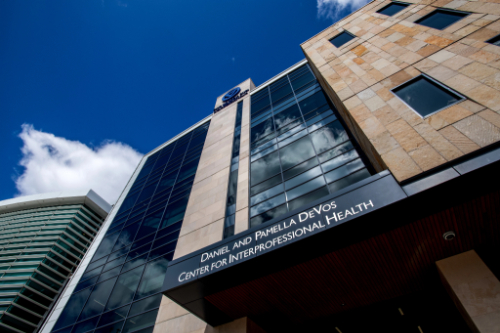
Cook-DeVos Center for Health Sciences
Grand Valley State University
301 Michigan Street NE, Suite 212
Grand Rapids, MI 49503-3314
Telephone: (616) 331-2734
Web: www.gvsu.edu/ot
or
Admissions Office
Grand Valley State University
1 Campus Drive
Allendale, MI 49401-9403
Telephone: (616) 331-2025 or (800) 748-0246
Email: admissions@gvsu.edu
Web: www.gvsu.edu/admissions
Additional Information
The program is accredited by the Accreditation Council for Occupational Therapy Education (ACOTE) of the American Occupational Therapy Association (AOTA). Graduates of the program will be able to sit for the national certification examination for the occupational therapist, administered by the National Board for Certification on Occupational Therapy (NBCOT). After successful completion of this exam, the individual will be an Occupational Therapist, Registered (OTR). Most states require licensure in order to practice; state licenses are usually based on the results of the NBCOT Certification Examination.
Professional Program Requirements
HPR 688 - Health Professions Research I Credits: 3
or HPR 690 - Master's Thesis Proposal Credits: 1 to 3
HPR 689 - Health Professions Research II Credits: 3
or HPR 695 - Master's Thesis Credits: 3
OT 550 - Foundational Perspectives in OT Credits: 2
OT 551 - Meaningful Living Through Occupation Credits: 3
OT 552 - Meaningful Living Laboratory Credits: 2
OT 553 - Level I Fieldwork (Part 1) Credits: 2
OT 560 - Foundations of Child & Adolescent Practice Credits: 2
OT 561 - Child & Adolescent Practice Credits: 3
OT 562 - Child and Adolescent Laboratory Credits: 2
OT 563 - Level I Fieldwork (Part 2) Credits: 2
OT 564 - Occupational Therapy Research Methods Credits: 4
OT 570 - Foundations of Adult Practice Credits: 2
OT 571 - Adult Practice Credits: 3
OT 572 - Adult Laboratory Credits: 2
OT 573 - Level I Fieldwork (Part 3) Credits: 2
OT 650 - Foundations of Older Adult Practice Credits: 3
OT 651 - Older Adult Practice Credits: 3
OT 652 - Older Adult Laboratory Credits: 2
OT 653 - Level I Fieldwork (Part 4) Credits: 2
OT 660 - Level II Fieldwork (Part 1) Credits: 9
Level II fieldwork must be completed within 24 months of completion of academic program.
OT 661 - Level II Fieldwork (Part 2) Credits: 9
Level II fieldwork must be completed within 24 months of completion of academic program.
PA 535 - Grant Writing Credits: 3
STA 610 - Applied Statistics for Health Professions Credits: 3
and one elective
Information for International Students
In this program, we emphasize effective communication including academic writing appropriate to the discipline as well as the ability to effectively collaborate with other students. Each student is required to perform independent work with appropriate academic citation when the work of others is used. International student applicants should be able to communicate well in English. Minimum scores of TOEFL 610 or computer-based TOEFL 253 are expected.
Grand Valley offers research opportunities to all graduate students. Some students will collaborate with faculty on ongoing research projects and other students will find or create research opportunities independently.
To be a successful as a full-time graduate student, students spend at least 40 hours per week on academic activities including going to class, doing homework, preparing for exams, reading, and working on semester-long projects.
Students who are applying need to interact directly with the program director or program admissions director. Please study the program Web site for detailed information about the program well before enrolling.